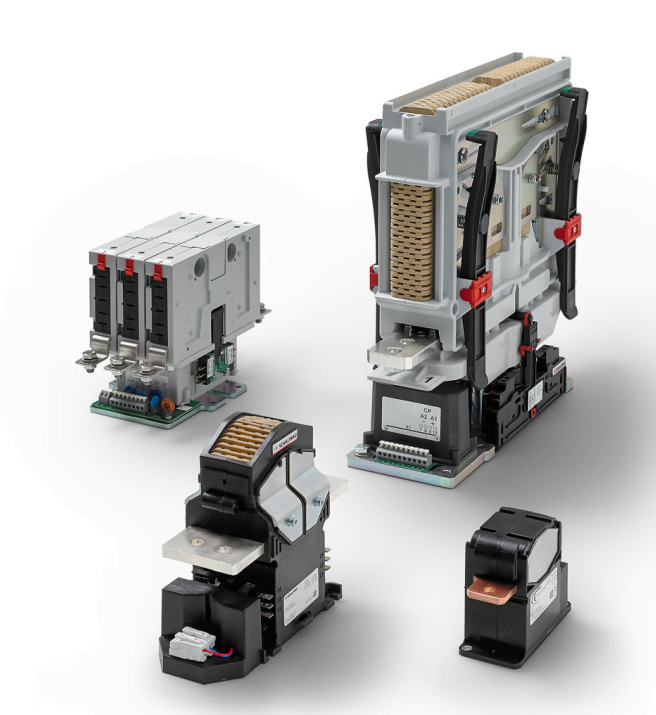
The contactors in a train switch the high currents in the main circuit, traction and auxiliary power. They must withstand high voltages, heavy vibration and thousands of operations a year without failing. Industrikomponenter AB (Inkom) has supplied components to Nordic railways since 1967 and is the Nordic partner of Schaltbau, one of the world’s leading manufacturers of contactors for rolling stock.
Main contactors connect and protect the supply to the traction converters and auxiliary converters. If a fault occurs, a redundant main contactor can keep the rest of the system running.
Traction contactors safely disconnect the traction motors, for example in the event of a short circuit at the inverter output. This is especially important for permanent magnet motors, which keep generating voltage as long as they rotate.
Pre-charge contactors charge the DC link capacitor gently through a resistor before the main contactor closes. This limits the inrush current and protects the main contactor’s contacts.
Schaltbau’s high-power contactors are tested to IEC 60077, the railway standard for electrical equipment on rolling stock. CT and CPP are also tested to GB/T 14048.4 and UL/IEC 60947-4-1. C360 is approved to EN 60077-2 and by DNV for marine use. R400 meets IEC 60077-1/-2, IEC 61373 (shock and vibration) and IEC 62497-1.
Why Inkom
All our sales engineers have a technical background and help you choose the right contactor for voltage, current and application.
We supply train manufacturers, maintenance organisations and refurbishment projects across the Nordic countries.
Framework agreements and delivery schedules for recurring needs.
We have represented Schaltbau in the Nordic region for many years and have direct contact with the factory in Munich.
Questions and answers
What is the difference between a main contactor and a traction contactor?
The main contactor connects the supply from the overhead line or the battery to the converters. The traction contactor sits between the inverter and the motor and disconnects the motor in the event of a fault.
Why is a pre-charge contactor needed?
When the main contactor closes onto a discharged capacitor, a very high inrush current occurs. The pre-charge contactor first charges the capacitor through a resistor, so the main contactor can close without wearing its contacts.
What does bidirectional mean?
That the contactor breaks direct current equally safely in both current directions. This matters in trains with regenerative braking and in battery systems, where current flows both ways.