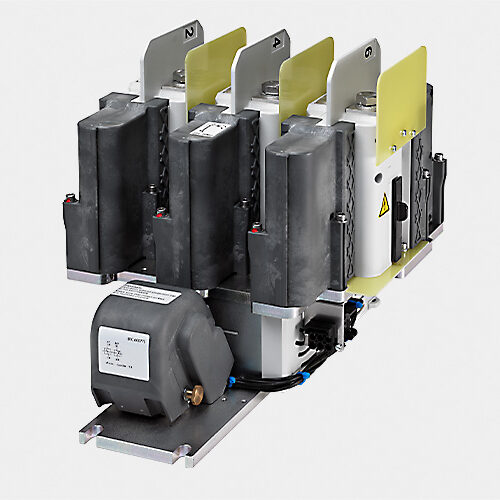
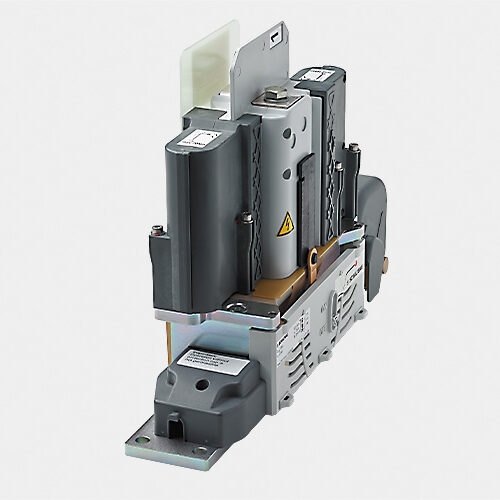
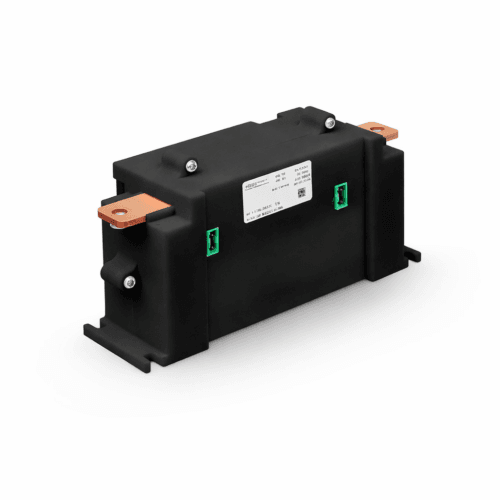
Contactors

See also our overview of DC contactors for railway.
This question must be broken down into several parameters. The amount of current that can flow through the contactor continuously is determined by the heat dissipation capacity and the maximum continuous current is often referred to as Ith or thermal current. Often a higher current can be run for a shorter time.
When switching off or breaking under load, an arc is always created. The energy in the arc is determined by the current and voltage and the type of load being broken. The arc is ionized gas, s.k. plasma. The energy of the arc is very high and powerfully destructive for the e.g. the contacts. Depending on the design, the contactor can handle the arc in different ways. The aim is always to cool the energy in the arc to create a safe situation and reduce wear and tear. The breaking capacity is always given in amperes at a specific voltage and time constant of the load.
When switching under load, small arcs may form but these disappear as soon as the contact is closed. The capacity for switching is often much greater than for breaking and is given in amperes at a specific voltage and time constant for the load.
In each contactor there is a coil that operates switching and breaking, the voltage to control the coil can vary depending on the application, normally in industry is 24VDC. The contactor may also contain a PCB that controls switching on and off. Some contactors have more than one coil to reduce power consumption. Usually one more powerful to close the plug and one that draws less current to keep the plug closed. This has in modern Schaltbau contactors often been replaced by only one coil controlled by PWM signal to achieve lower power consumption and lighter contactor.
The contactor can either be controlled to one mode or both modes, for switching on or off. For example, a monostable controls the switch-on by coil, while the switch-off is controlled by a spring if the coil voltage is broken. A bistable controls both striking and breaking with the coil. A bistable contactor uses no energy to keep the contactor in the respective position.
Read more about our contactors here.
For each contactor, there is a short-circuit current and a time that it must withstand. If this is higher and longer than the specification, there is a risk that the contactor will weld together. What happens is that the magnetic field in the contact bridge forces the contact bridge apart and small arcs can form with the subsequent risk of the contactor welding the contact bridge. Alternatively, the heat in the contact points can be so high that they melt together.
High short-circuit currents and an unregulated closing with load is the most common reason for the contactor to weld. This is usually due to an insufficient pre-charge. Read more about Pre-charge here.
Excessive and high short-circuit currents can cause the contact bridge to lift and open due to the magnetic field generated by the current, called levitation. This can cause the contactor to weld because when the contactor bridge opens, micro arcing and extensive heating occur.
Breaking higher loads than the contactor is designed for, especially high inductance can cause the contactor bridge to weld.
Using silver oxide on the contactor pills increases the resistance to welding.
Read more about our contactors here.
A contactor is defined according to IEV ref 441-14-33 as a mechanical switching device with only one rest position, operated other than by hand, capable of switching on, conducting and breaking currents under normal circuit conditions including operational overload.
In common parlance, this usually refers to an electromechanical contactor where the operation of switching on and off is done by means of an electrically driven coil. Simply put, the contactor is essentially a switch for electrical power in the same way that a relay is a switch for electrical signals or small loads.
With electrification and higher voltages in systems, contactors capable of extinguishing the resulting arc are required to safely interrupt the current, even under load in an emergency. It is therefore important to have the right contactor for the purpose. Factors to consider when choosing a contactor are current, voltage, current direction, inductance, short-circuit current, etc. This is to ensure that the current is actually broken and does not lead to more catastrophic events such as fire or similar, read more about risks here. Please contact us for help in choosing a contactor for your system.
See our range of contactors and contacts here

Historically, contactors have been used to directly switch on and off electrical loads, such as electric motors, and even today they are used this way in many applications. In modern systems, however, starting and stopping is often done electronically and the purpose of the contactor is mainly to enable galvanic separation and to act as a switch in the event of an abnormality or fault in the system.
A contactor is a vital safety component in any electrical system, Schaltbau stands for new patented technology. By far the longest life cycle, resulting in a low price. The patented open arc chamber technology will be larger in volume. Achieving the highest level of safety requires longevity, technical innovation and documented approval.
Traditionally, contactors have worked with coils to force the arc to the arc chamber for extinguishing. During arc formation, the coil is energized and its magnetic field affects the arc. A disadvantage of this solution is that it takes time to recharge the coils, which means that the arc stays longer and causes more wear and tear.
However, a much bigger problem is that at low currents in the coils, the magnetic field is too small to force the arc to the arc chamber. This results in so-called “standing arc” which damages both the contactor and causes undesirable knock-on effects in the systems. To reduce the problem at low currents, permanent magnets have been applied to influence the arc. However, these are dependent on the direction of the current in the contactor and thus do not work in alternating current or if DC is to pass through the contactor in both directions.
However, with a patented and innovative concept in its latest contactors, such as the C310, Schaltbau has abandoned the coils and affects the arc only with permanent magnets and smart design of the arc chamber. They can be used for AC, DC in both directions and are completely independent of the current at break due to the permanent magnets.
When an electromechanical component such as a contactor is exposed to a situation that causes it to fail, it does so safely. A contactor that has arc extinguishing in air will be able to break the current without damaging other components. In gas-filled and contactors with closed arcing chambers, there is a risk of large pressure differences occurring due to. heating, this can lead to explosions with uncontrolled consequences, e.g. current conductors can risk damaging surrounding components.
It will form an arc with a lot of energy. The best way to extinguish it is with permanent magnets by dragging the arc to the arc chamber where the arc is extinguished. An arc extinguishing contactor in air can handle the energy better than gas filled ones as the expanding gases in the arc can be vented.


Contactors
Contactors
Contactors
Contactors
Contactors

Contactors

Contactors

Contactors
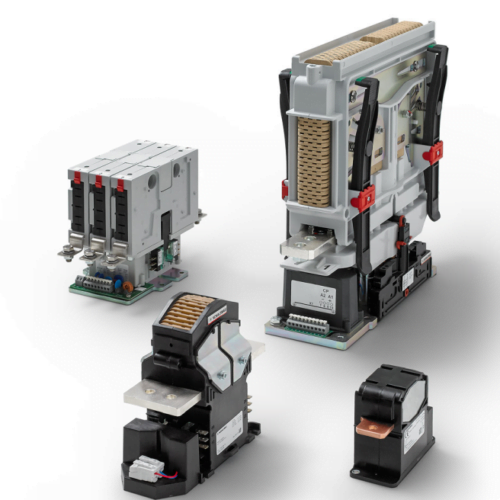
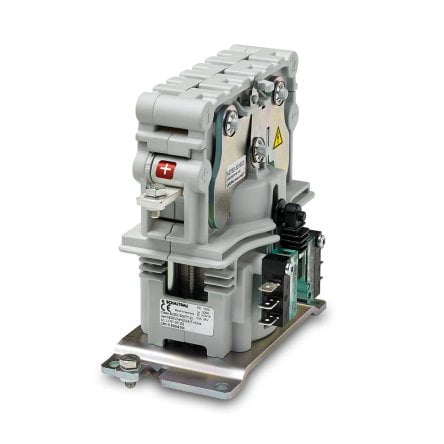
CA is Schaltbau’s AC contactor for railway applications, available in 1- and 3-pole versions for 1,500 or 3,000 V and 400 or 800 A. It breaks safely even at supply frequencies up to 400 Hz and is used as a traction contactor for inverter-fed permanent magnet motors in trains and multiple units. CA is also used on the AC side of inverters in solar and wind power plants. Tested to the railway standard IEC 60077.