


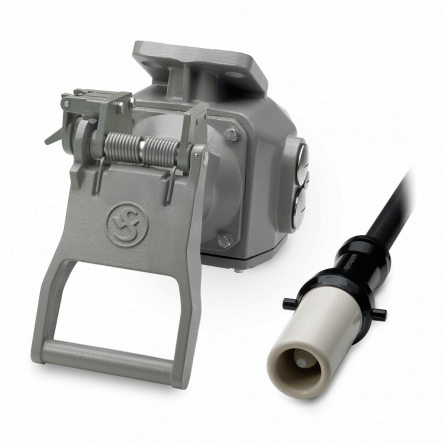
Connectors

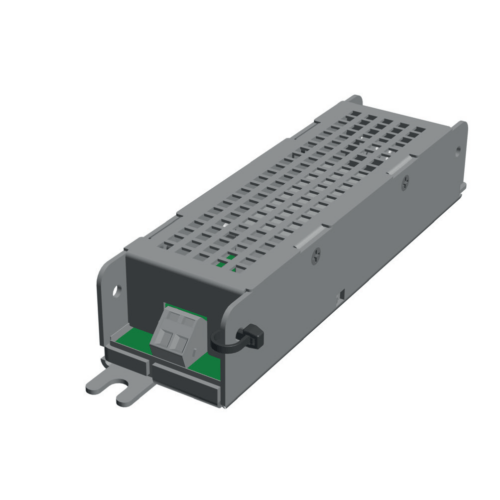
Voltage indicator:
Den aktiveras automatiskt och börjar blinka med röd LED när spänningen överstiger 48 VDC, vilket ger en tydlig visuell varning och bidrar till en tryggare arbetsmiljö.
The indicator is designed with two separate sections for built-in redundancy.
Kontaktdon:
Number of contacts
2 pole + PE + 2 + 2
Rated voltage Ue
Power contacts 1+2: 1,000 V DC
Signal contacts 3+4: 60 V DC
Signal contacts 6+7: 60 V DC
Rated current Ie
Power contacts 1+2: 470 A max. @ 95 mm2
Signal contacts 3+4: 30 A max. @ 10 mm2
Signal contacts 6+7: 5 A max. @ 1.5 mm2
Wire gauge
Power contacts 1+2: ø10 mm, 35 / 50 / 70 / 95 mm2
Signal contacts 3+4: ø4 mm, 0.5 / 0.75…1 / 1.5 / 2.5 / 4 / 6 / 10 mm2
Signal contacts 6+7: ø3 mm, 0.5 / 0.75…1 / 1.5 / 2.5 mm2
Material, shells
Socket: Aluminium die-cast, black
Plug: Polyamid PA 6.6, black
Contact inserts: Polyamid PA 6.6, black
Dichtungsteile: Silikon
Feedback contact plug inserted
1x in socket shell, S870 series, SPDT, 10 A
Coupling
Socket housing with handle and one-hand lock
IP rating (IEC 60529)
IP69K: When mated, socket with closed lid, plug in dummy socket
Mechanical endurance
> 10,000 mating cycles
Temperature range
–40° C … +85° C
A DC lab, or direct current lab, is a laboratory environment used to conduct experiments and tests with DC circuits and components.
Direct current (DC) is very different from alternating current (AC) in terms of insulation distance, which affects safety. Since DC does not change direction as AC does and thus does not pass through zero, it is easier for an arc to form and remain stationary. This is a safety aspect that is important to consider when it comes to DC labs and their design.
A contactor is defined according to IEV ref 441-14-33 as a mechanical switching device with only one rest position, operated other than by hand, capable of switching on, conducting and breaking currents under normal circuit conditions including operational overload.
In common parlance, this usually refers to an electromechanical contactor where the operation of switching on and off is done by means of an electrically driven coil. Simply put, the contactor is essentially a switch for electrical power in the same way that a relay is a switch for electrical signals or small loads.
With electrification and higher voltages in systems, contactors capable of extinguishing the resulting arc are required to safely interrupt the current, even under load in an emergency. It is therefore important to have the right contactor for the purpose. Factors to consider when choosing a contactor are current, voltage, current direction, inductance, short-circuit current, etc. This is to ensure that the current is actually broken and does not lead to more catastrophic events such as fire or similar, read more about risks here. Please contact us for help in choosing a contactor for your system.
See our range of contactors and contacts here

In each contactor there is a coil that operates switching and breaking, the voltage to control the coil can vary depending on the application, normally in industry is 24VDC. The contactor may also contain a PCB that controls switching on and off. Some contactors have more than one coil to reduce power consumption. Usually one more powerful to close the plug and one that draws less current to keep the plug closed. This has in modern Schaltbau contactors often been replaced by only one coil controlled by PWM signal to achieve lower power consumption and lighter contactor.
Historically, contactors have been used to directly switch on and off electrical loads, such as electric motors, and even today they are used this way in many applications. In modern systems, however, starting and stopping is often done electronically and the purpose of the contactor is mainly to enable galvanic separation and to act as a switch in the event of an abnormality or fault in the system.
A contactor is a vital safety component in any electrical system, Schaltbau stands for new patented technology. By far the longest life cycle, resulting in a low price. The patented open arc chamber technology will be larger in volume. Achieving the highest level of safety requires longevity, technical innovation and documented approval.



Connectors
Connectors

Current & Voltage Sensors

Connectors

Connectors

Connectors
Connectors
Connectors
Denna kopplingsbox är utvecklad för säker och smidig hantering av högspänningssystem, exempelvis i laboratoriemiljöer och batterilabb. Produkten gör det enkelt för användaren att avgöra när ett system är helt spänningslöst, vilket möjliggör säker anslutning och frånkoppling av kablar utan risk för elchock.
Kopplingsboxen är utrustad med en tydlig spänningsindikator som visar om det finns spänning kvar i systemet. Innan kablar kopplas i eller ur kan användaren snabbt kontrollera indikatorn för att säkerställa att systemet är utan spänning. Detta minskar risken för olyckor och bidrar till en tryggare arbetsmiljö vid arbete med högspänning.
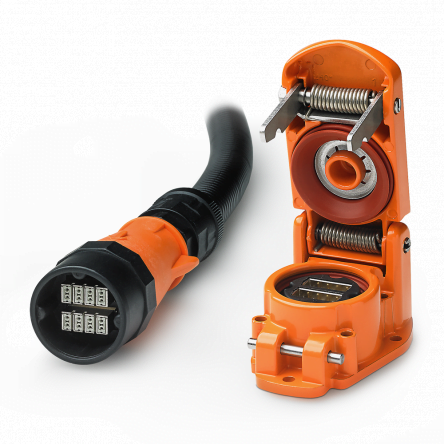
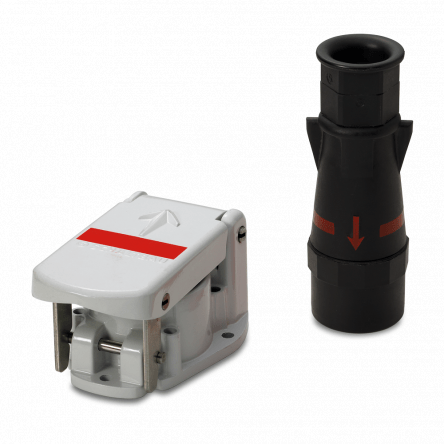
Produkten är byggd med mycket robusta kontaktdon från Schaltbau som är konstruerade för att tåla frekventa anslutningar och frånkopplingar. Den hållbara designen gör kopplingsboxen väl lämpad för testmiljöer där utrustning ofta behöver kopplas om, till exempel i utvecklings- och forskningslabb.
Kontaktor kan väljas till för ökad redundans.