
Contactors

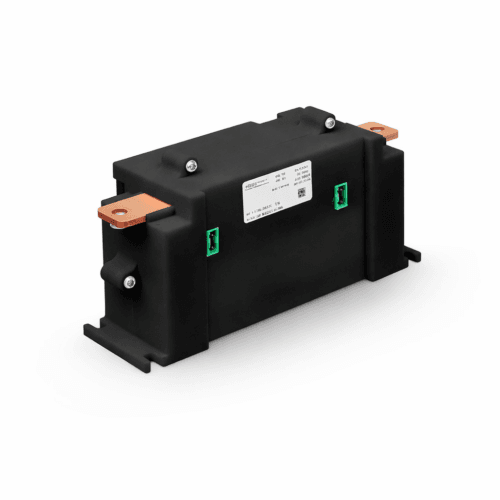
Low thermal losses: The C803 has a very low contact resistance of about 100 µOhm, which minimizes the need for additional cooling and simplifies thermal management in the system.
High performance in a compact format: With a breakdown voltage of up to 1,500V, high switching currents and a weight of less than 0.5 kg, the C803 is an excellent choice for inverter, charging and auxiliary system applications.
Robust for harsh environments: The contactor is designed to withstand over 200,000 operations and meets the vibration requirements of ISO 16750-3. It is built to withstand the rigors of heavy vehicles such as trucks, excavators and other off-road applications.
Versatile use: C803 is compatible with a wide range of e-mobility systems – from industrial vehicles to passenger cars – and offers flexible mounting, both vertically and horizontally, in compliance with global safety standards.
NO = Normally Open, NC = Normally Closed. This describes the state of a contactor when the voltage in the system is off. Normally open (NO) is mostly used in electrical systems where, for safety reasons, you want to be sure that the contactor opens when the power is cut in the system in case of a power failure. Normally Closed (NC) is often used when you want to be sure that the contactor closes a circuit in the event of a voltage drop, such as a power failure. to drain the system of energy to earth.
Read more about our DC contactors for both high and low voltage here.
This question must be broken down into several parameters. The amount of current that can flow through the contactor continuously is determined by the heat dissipation capacity and the maximum continuous current is often referred to as Ith or thermal current. Often a higher current can be run for a shorter time.
When switching off or breaking under load, an arc is always created. The energy in the arc is determined by the current and voltage and the type of load being broken. The arc is ionized gas, s.k. plasma. The energy of the arc is very high and powerfully destructive for the e.g. the contacts. Depending on the design, the contactor can handle the arc in different ways. The aim is always to cool the energy in the arc to create a safe situation and reduce wear and tear. The breaking capacity is always given in amperes at a specific voltage and time constant of the load.
When switching under load, small arcs may form but these disappear as soon as the contact is closed. The capacity for switching is often much greater than for breaking and is given in amperes at a specific voltage and time constant for the load.
In each contactor there is a coil that operates switching and breaking, the voltage to control the coil can vary depending on the application, normally in industry is 24VDC. The contactor may also contain a PCB that controls switching on and off. Some contactors have more than one coil to reduce power consumption. Usually one more powerful to close the plug and one that draws less current to keep the plug closed. This has in modern Schaltbau contactors often been replaced by only one coil controlled by PWM signal to achieve lower power consumption and lighter contactor.
With a contactor, you want to break the current safely and get rid of the arc that forms as quickly as possible. Since an arc occurs due to potential difference, the arc breaks itself in an alternating current (AC) application when the voltage crosses zero. In the case of direct current (DC), the current is constantly above zero and is therefore more difficult to break.
In the switching sequence, you want to increase the voltage in the arc to a higher voltage than that of the
the supply voltage
. This eventually eliminates the arc and stops conducting current. There are four ways to increase the voltage of the arc:

The most common way to achieve this is by using
magnetic blasting
.
An AC contactor is usually designed to break all three phases simultaneously, so there are three connection poles. However, since it is easier to break the alternating current, the design does not need to maximize the above-mentioned factors to increase the voltage in the arc. This means that the design of an AC contactor is simpler but takes up a lot of space.
One way to develop a DC contactor is to take an oversized AC contactor and build the poles so that it is single-pole but breaks the same pole three times. This is a technique that works, but the design is not optimal as the contactor becomes large and wears out quickly if it breaks under load.
A robust DC contactor is usually designed to break one pole and optimized for that. But since breaking AC is more difficult, all four factors need to be maximized to increase the voltage. This is done here with a permanent magnet and an open arc chamber that has ceramic parts to split the arc. In addition, a design to pull it out and make it longer and narrower, as well as cooling it.
The contactor can either be controlled to one mode or both modes, for switching on or off. For example, a monostable controls the switch-on by coil, while the switch-off is controlled by a spring if the coil voltage is broken. A bistable controls both striking and breaking with the coil. A bistable contactor uses no energy to keep the contactor in the respective position.
Read more about our contactors here.
Vacuum contactors use encapsulated contacts with vacuum instead of air as the medium to eliminate arcing. Vacuum contactors are only applicable for use in AC applications. The AC arc generated by the opening of the contacts will itself be extinguished at the zero crossing of the current waveform, the vacuum preventing a re-ignition of the arc across the open contacts.
A contactor is defined according to IEV ref 441-14-33 as a mechanical switching device with only one rest position, operated other than by hand, capable of switching on, conducting and breaking currents under normal circuit conditions including operational overload.
In common parlance, this usually refers to an electromechanical contactor where the operation of switching on and off is done by means of an electrically driven coil. Simply put, the contactor is essentially a switch for electrical power in the same way that a relay is a switch for electrical signals or small loads.
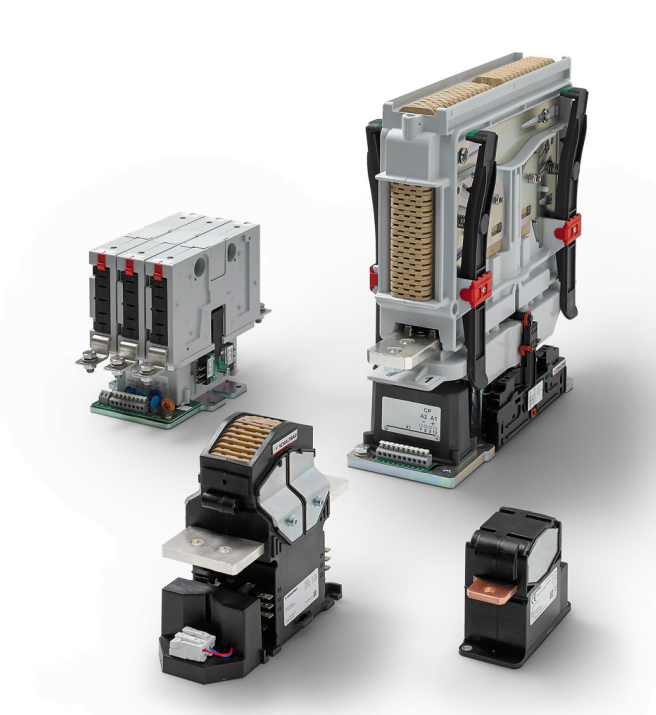
With electrification and higher voltages in systems, contactors capable of extinguishing the resulting arc are required to safely interrupt the current, even under load in an emergency. It is therefore important to have the right contactor for the purpose. Factors to consider when choosing a contactor are current, voltage, current direction, inductance, short-circuit current, etc. This is to ensure that the current is actually broken and does not lead to more catastrophic events such as fire or similar, read more about risks here. Please contact us for help in choosing a contactor for your system.
See our range of contactors and contacts here

High short-circuit currents and an unregulated closing with load is the most common reason for the contactor to weld. This is usually due to an insufficient pre-charge. Read more about Pre-charge here.
Excessive and high short-circuit currents can cause the contact bridge to lift and open due to the magnetic field generated by the current, called levitation. This can cause the contactor to weld because when the contactor bridge opens, micro arcing and extensive heating occur.
Breaking higher loads than the contactor is designed for, especially high inductance can cause the contactor bridge to weld.
Using silver oxide on the contactor pills increases the resistance to welding.
Read more about our contactors here.
For each contactor, there is a short-circuit current and a time that it must withstand. If this is higher and longer than the specification, there is a risk that the contactor will weld together. What happens is that the magnetic field in the contact bridge forces the contact bridge apart and small arcs can form with the subsequent risk of the contactor welding the contact bridge. Alternatively, the heat in the contact points can be so high that they melt together.
Historically, contactors have been used to directly switch on and off electrical loads, such as electric motors, and even today they are used this way in many applications. In modern systems, however, starting and stopping is often done electronically and the purpose of the contactor is mainly to enable galvanic separation and to act as a switch in the event of an abnormality or fault in the system.
A contactor is a vital safety component in any electrical system, Schaltbau stands for new patented technology. By far the longest life cycle, resulting in a low price. The patented open arc chamber technology will be larger in volume. Achieving the highest level of safety requires longevity, technical innovation and documented approval.
Pre-charge, in the context of a DC (direct current) system, refers to a process of gradually charging the capacitance or voltage level before the main power is switched on. The purpose of pre-charge is to reduce the initial current spike and thus avoid damage to the system and components.
When a DC system is started or reconnected after having been disconnected for a period of time, capacitances, such as for example capacitors, be fully discharged. Directly allowing the full voltage level to be applied to these capacitances can cause a sudden current spike that can be detrimental to components and the system as a whole. This current spike can be particularly problematic in power systems where high currents can cause disturbances or damage.
To avoid this, the pre-charge method is used. It involves gradually increasing the voltage level across the capacitances by using a limited current or a resistance-based power source. By slowly increasing the voltage across the capacitances, you can smooth out the current spike and protect the system. Once the voltage has increased to the desired level, the main power can be switched on and the system can operate normally.
Pre-charge is often used in areas such as power transmission, electric power systems and similar DC systems where capacitances may be present and current spikes should be avoided to protect equipment and ensure proper operation. In such a circuit, a pre-charge contactor is used.
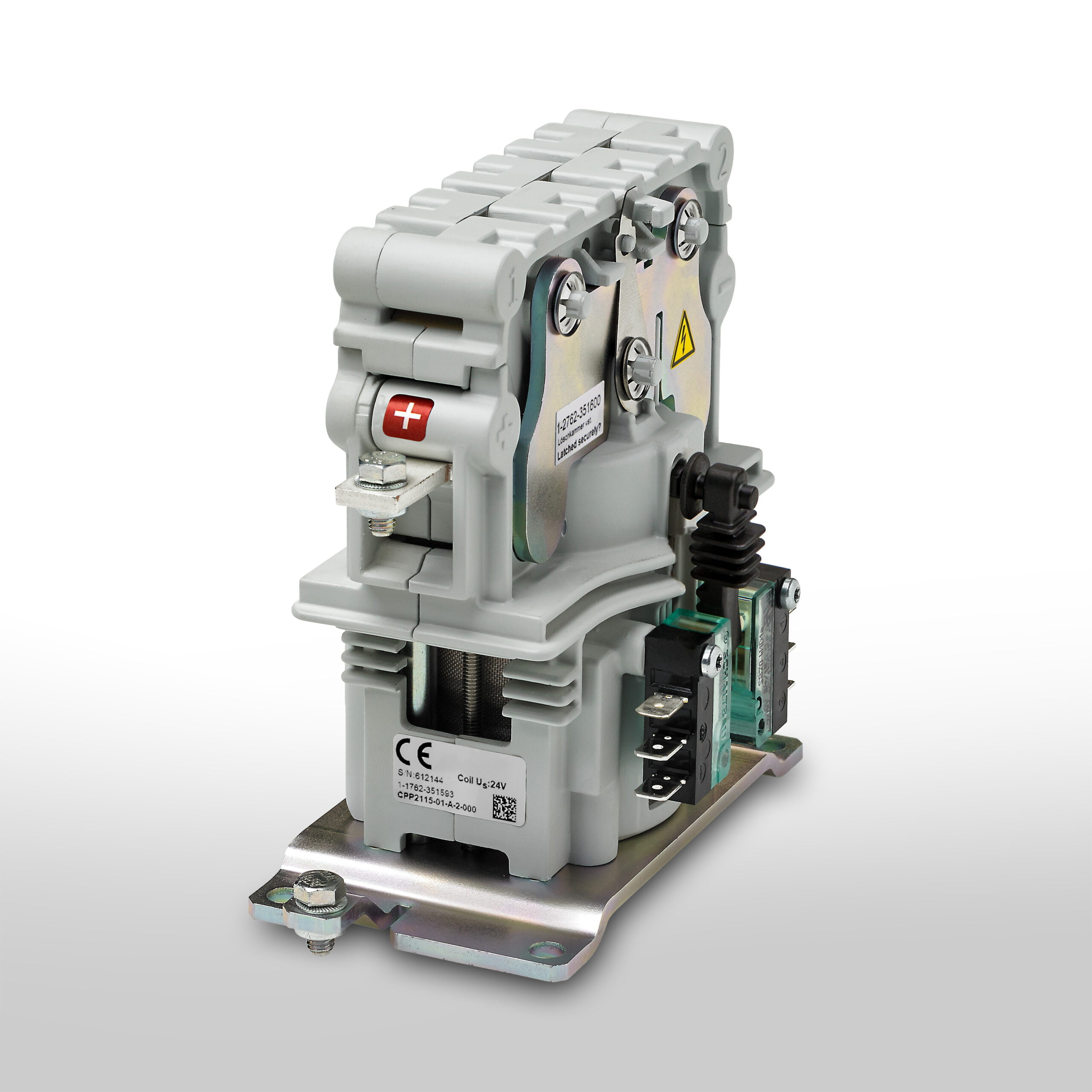
When an electromechanical component such as a contactor is exposed to a situation that causes it to fail, it does so safely. A contactor that has arc extinguishing in air will be able to break the current without damaging other components. In gas-filled and contactors with closed arcing chambers, there is a risk of large pressure differences occurring due to. heating, this can lead to explosions with uncontrolled consequences, e.g. current conductors can risk damaging surrounding components.
It will form an arc with a lot of energy. The best way to extinguish it is with permanent magnets by dragging the arc to the arc chamber where the arc is extinguished. An arc extinguishing contactor in air can handle the energy better than gas filled ones as the expanding gases in the arc can be vented.


Contactors
Contactors

Contactors
Contactors

Contactors

Contactors

Contactors

Contactors
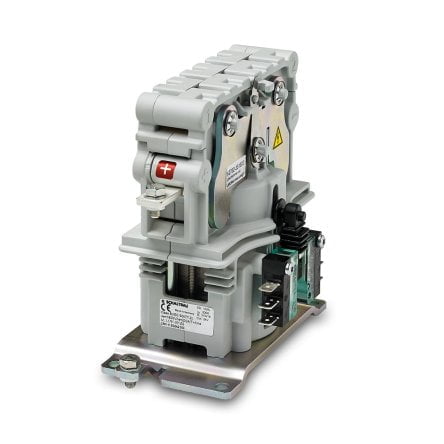
With the C803, we set a new standard for performance, robustness and efficiency. It is designed to meet the tough demands of commercial vehicles as well as off-road and passenger cars – and, of course, it meets the high safety and quality requirements that characterize today’s rapidly growing markets for electric vehicles (EV) and industrial applications.
Developed to meet the specific needs of the automotive industry, the C803 combines compact design with high performance. Thanks to this, it fits perfectly in a wide range of applications, such as inverters, charging systems and auxiliary power systems.