Contactors

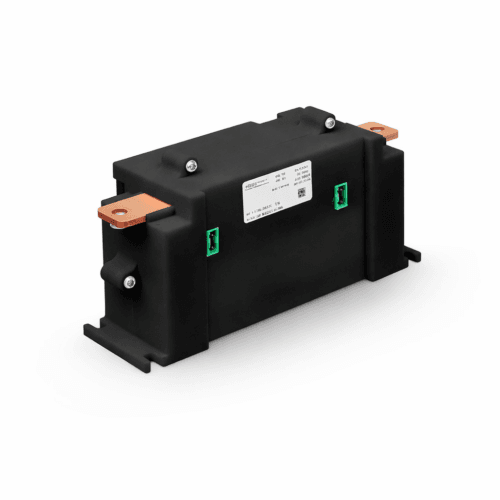
The SC503 is designed for applications where intelligent monitoring and fast switching are essential. Through integrated measurement and communication, the system can make local decisions and reduce the risk of downtime.
Main technical data and features:
Operating voltage: approx. 600-800 V DC
Rated current: up to 300 A
Semiconductor version for fast switching cycles up to about 70 A
Conventional electromechanical version for higher loads
Active measurement of voltage and current in real time
Support for Modbus RTU and Modbus TCP/IP
Direct control via I/O interface
Possibility of local logic and quick response in case of failure or overload
The SC503 is suitable for energy storage, industrial DC grids, vehicles and other applications where safe, connected and efficient power control is a central part of the system design.
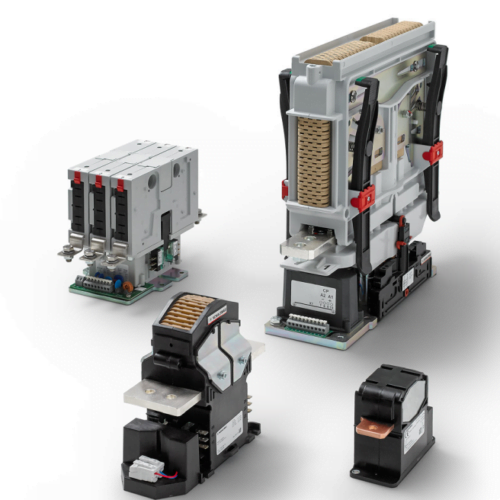
A contactor is defined according to IEV ref 441-14-33 as a mechanical switching device with only one rest position, operated other than by hand, capable of switching on, conducting and breaking currents under normal circuit conditions including operational overload.
In common parlance, this usually refers to an electromechanical contactor where the operation of switching on and off is done by means of an electrically driven coil. Simply put, the contactor is essentially a switch for electrical power in the same way that a relay is a switch for electrical signals or small loads.
With electrification and higher voltages in systems, contactors capable of extinguishing the resulting arc are required to safely interrupt the current, even under load in an emergency. It is therefore important to have the right contactor for the purpose. Factors to consider when choosing a contactor are current, voltage, current direction, inductance, short-circuit current, etc. This is to ensure that the current is actually broken and does not lead to more catastrophic events such as fire or similar, read more about risks here. Please contact us for help in choosing a contactor for your system.
See our range of contactors and contacts here

In each contactor there is a coil that operates switching and breaking, the voltage to control the coil can vary depending on the application, normally in industry is 24VDC. The contactor may also contain a PCB that controls switching on and off. Some contactors have more than one coil to reduce power consumption. Usually one more powerful to close the plug and one that draws less current to keep the plug closed. This has in modern Schaltbau contactors often been replaced by only one coil controlled by PWM signal to achieve lower power consumption and lighter contactor.
This question must be broken down into several parameters. The amount of current that can flow through the contactor continuously is determined by the heat dissipation capacity and the maximum continuous current is often referred to as Ith or thermal current. Often a higher current can be run for a shorter time.
When switching off or breaking under load, an arc is always created. The energy in the arc is determined by the current and voltage and the type of load being broken. The arc is ionized gas, s.k. plasma. The energy of the arc is very high and powerfully destructive for the e.g. the contacts. Depending on the design, the contactor can handle the arc in different ways. The aim is always to cool the energy in the arc to create a safe situation and reduce wear and tear. The breaking capacity is always given in amperes at a specific voltage and time constant of the load.
When switching under load, small arcs may form but these disappear as soon as the contact is closed. The capacity for switching is often much greater than for breaking and is given in amperes at a specific voltage and time constant for the load.
Historically, contactors have been used to directly switch on and off electrical loads, such as electric motors, and even today they are used this way in many applications. In modern systems, however, starting and stopping is often done electronically and the purpose of the contactor is mainly to enable galvanic separation and to act as a switch in the event of an abnormality or fault in the system.



Contactors

Contactors
Contactors

Contactors

Contactors

Contactors

Contactors

Contactors
The SC503 is an intelligent contactor from Schaltbau developed to increase safety, efficiency and system control in modern electrical installations. It is equipped with active measurement of both voltage and current directly at the switching point, enabling real-time monitoring and fast local decisions. The contactor is available in both fast semiconductor version and robust conventional variant for different load ranges. With integrated communication and control interfaces, the SC503 can be easily integrated into automation and control systems. It is optimized for high-performance AC and DC applications with high reliability requirements.